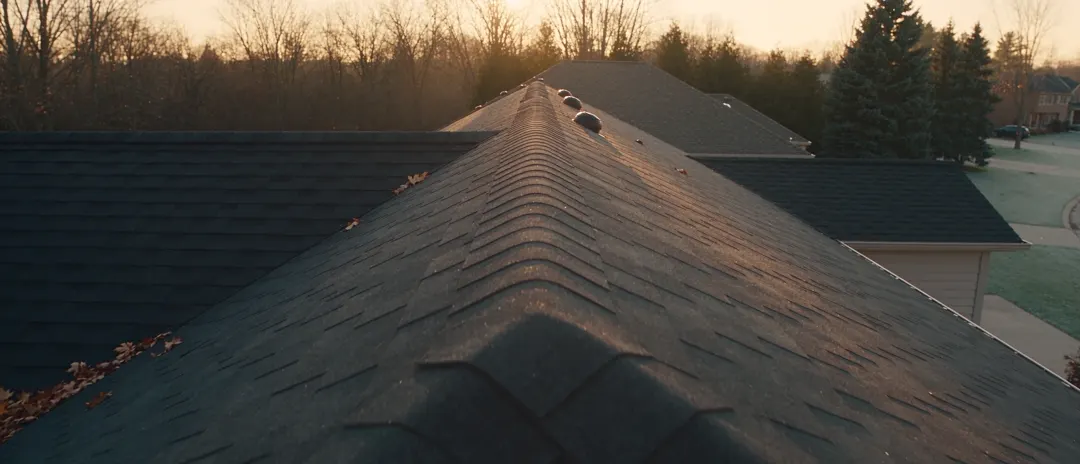
Roofing Ottawa · Residential and commercial Roofing in Ottawa, built layer by layer for the snow load.
Roof replacement, repairs, metal and flat roofs and eavestroughs, by a crew with 10+ years on Ottawa roofs. GAF and IKO certified, insured with WSIB coverage, and every install backed by a 10-year written workmanship warranty.
- 10+ years on Ottawa roofs
- GAF and IKO certified
- 10-year written workmanship warranty
- 24/7 emergency calls
- Insured, with WSIB coverage
Sheet 01 · Roofing in Ottawa
A roof is a system, not a colour
Most people choose a roof by its colour. The colour is the last two millimetres. Under it sit eight more layers, each with one job, and an Ottawa winter tests every one of them: a 1-in-50-year snow load of 2.4 kilopascals, around 4,500 heating degree-days, thaws in January that refreeze overnight, and summer storms that, in May 2022, pushed gusts to an estimated 190 km/h.
We are a crew with 10+ years on Ottawa roofs, certified with GAF and IKO, insured with WSIB coverage, and we back every installation with a 10-year written workmanship warranty. We replace and repair shingle roofs, install metal and flat roofs, look after commercial buildings and hang the eavestroughs that carry the water away. We answer emergency calls 24 hours a day, every day of the year.
Scroll down and the roof below will be torn off and rebuilt one layer at a time, the way we do it on a real house. Each layer comes with what it does and where the rule comes from, so when you compare quotes you will know what to ask for. Then use the tools to check your own roof, and book a free inspection when you are ready.
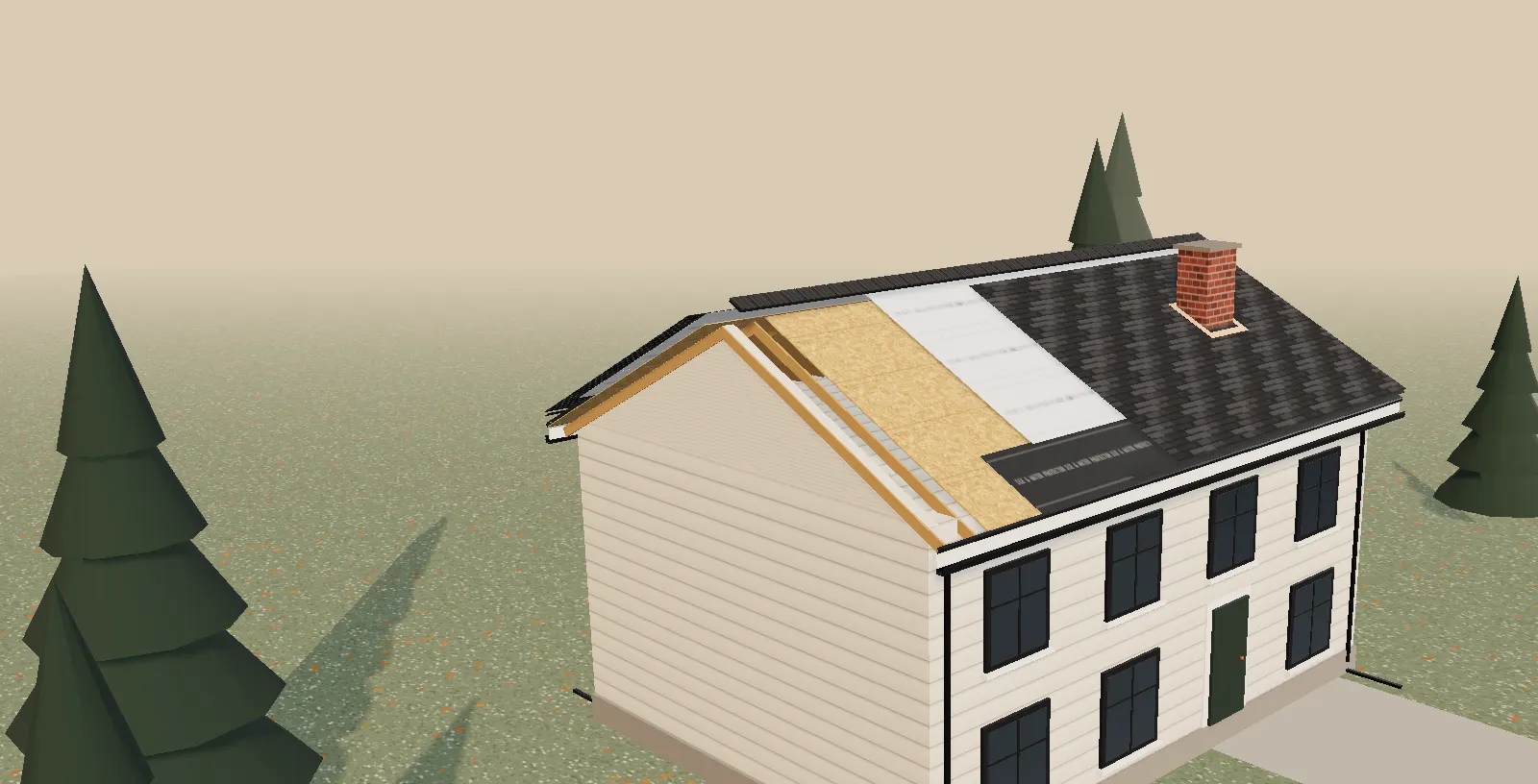
Sheet 02 · The roof, layer by layer
Your roof, rebuilt one layer at a time
Step 01 / 12Snow on top, ice at the edge
The roof you have now
Heat leaking up from the house melts the snow from underneath. The water runs down to the cold overhang and freezes into a ridge of ice. The next thaw backs up behind that ridge and finds its way under the shingles.
Source: Building Science Digest 135, Ice Dams; CMHC research on five Ottawa housesStep 02 / 12Down to the wood
Tear-off
Old shingles, felt, nails and tired flashing all come off, one section at a time, so the house is never left open to weather. Magnets sweep the lawn, beds and driveway before we leave each day.
Source: Our standard on every replacementStep 03 / 12Find the soft spots
The deck
With the roof open we walk every sheet. Soft, delaminated or rotted sheathing is cut out and replaced before anything goes on top, and you get photos of each panel we change.
Source: Photo report with every jobStep 04 / 12A metal lip at every edge
Drip edge
Prefinished metal along the eaves and rakes carries water past the fascia and into the eavestrough instead of letting it curl back into the wood.
Source: Part 9 of the Building Code covers drip edges in asphalt shingle applicationStep 05 / 12The part that stops ice dams leaking
Ice and water membrane
Ottawa sees about 4,500 heating degree-days a year, well above the 3,500 where the Building Code relaxes the rule. A self-sealing membrane runs from the edge at least 900 mm up the slope, to a line 300 mm inside the wall, and seals around every nail.
Source: Ontario Building Code 9.26.5.1; SB-1 Table 2Step 06 / 12A second skin, lapped to shed water
Underlayment
A synthetic underlayment covers the rest of the deck, each row lapped over the one below so any water that gets past a shingle is carried down and out, never into the wood.
Source: Manufacturer installation instructionsStep 07 / 12The first line against wind
Starter course
A starter strip with a factory sealant line glues down the first course at the edge, where wind gets its first grip. On May 21, 2022, the derecho brought gusts estimated at 190 km/h to Ottawa.
Source: Environment Canada estimate via the May 2022 Canadian derecho recordStep 08 / 12Course by course, nailed to pattern
Shingles
Architectural shingles go on in offset courses, nailed exactly where the manufacturer specifies. Today's shingles are commonly rated ASTM D3161 Class F, a fan test at 110 mph (177 km/h).
Source: ASTM D3161 and D7158 wind classes; NRC 2025 report on shingle wind testingStep 09 / 12Where most leaks start
Flashing
Chimneys, walls and skylights get step flashing woven into every course with at least a 75 mm head lap, then counter-flashing cut into the masonry so water has no seam to follow.
Source: National Building Code 9.26.4 (stepped flashing head lap)Step 10 / 12Cold roof, dry attic
Ridge vent
Air comes in at the soffits and leaves at the ridge, keeping the deck cold so snow melts evenly. Ventilation works best once the ceiling below is air-sealed, which is the real fix for most ice dams.
Source: CMHC, Attic venting, attic moisture and ice damsStep 11 / 12Water away from the foundation
Eavestroughs
Seamless troughs and downspouts that discharge at least 1.2 m from the foundation, or 3 m to a lawn or garden bed under the City's Rain Ready guidance.
Source: City of Ottawa, basement flooding prevention; Rain Ready OttawaStep 12 / 12Pick the finish for your house
Every layer at once
Here is the whole assembly, cut back layer by layer from the gable. Choose a shingle colour, standing seam metal or cedar to see it on the house; your pick is added to your inspection request.
Sheet 03 · Services
Every part of the roof, one crew
Shingles, metal, flat roofs and the eavestroughs that carry it all away. The same crew that inspects your roof is the crew that does the work, and the same written warranty covers all of it.
Roof replacement
Full tear-off, deck repairs and a complete new system, shingles to ridge vent, on one written price.
roof replacement in Ottawa02Roof repair
Leaks, lifted shingles, flashing and storm damage, with 24/7 emergency calls and same-day tarping.
roof repair in Ottawa03Metal roofing
Standing seam and steel panel roofs that shed snow and outlast two or three asphalt roofs.
metal roofing in Ottawa04Flat roofs
Two-ply modified bitumen and membrane roofs for garages, additions and infill homes.
flat roof work in Ottawa05Commercial roofing
Low-slope roofs on plazas, offices and multi-unit buildings, scheduled around tenants.
commercial roofing in Ottawa06Eavestroughs
Seamless aluminum eavestroughs, downspouts and leaf guards sized to the roof they drain.
eavestroughs in Ottawa07Gutter cleaning
Spring and fall eavestrough cleaning, flushed downspouts and a quick roof check while we are up.
gutter cleaning in Ottawa08Roof inspection
A written condition report with photos, for buyers, sellers, insurers or peace of mind.
roof inspection in Ottawa09Ice dam removal
Low-pressure steam removal of ice dams and careful clearing of heavy roof snow.
ice dam removal in OttawaSheet 04 · Design data
The numbers an Ottawa roof is built for
The Ontario Building Code gives every part of the province its own climate figures. Ottawa's are some of the toughest in the south of the province, and they explain most of what goes wrong with roofs here.
Ground snow load
The 1-in-50-year snow load roofs are designed around: about 245 kg on every square metre of ground. Kanata's figure is 2.5.
OBC SB-1, Table 2Heating degree-days
A measure of how cold and long the winter is. Above 3,500, the Code expects eave protection on shingle roofs; Ottawa is far above it.
OBC SB-1 Table 2; OBC 9.26.5.1January design temperature
The cold that only 2.5% of January hours fall below. Orleans' figure is −26 °C. Cold is what turns attic heat leaks into ice dams.
OBC SB-1, Table 2May 21, 2022
The estimated peak gust in Ottawa during the derecho, the sixth largest insured loss in Canadian history at over $875 million.
Insurance Bureau of Canada, June 2022| Location (SB-1) | Snow load Ss | Rain on snow Sr | Degree-days | January 2.5% |
|---|---|---|---|---|
| Ottawa (City Hall) | 2.4 kPa | 0.4 kPa | 4,440 | −25 °C |
| Kanata | 2.5 kPa | 0.4 kPa | 4,520 | −25 °C |
| Barrhaven | 2.4 kPa | 0.4 kPa | 4,500 | −25 °C |
| Orleans | 2.4 kPa | 0.4 kPa | 4,500 | −26 °C |
| Airport | 2.4 kPa | 0.4 kPa | 4,500 | −25 °C |
Why roofs fail here first at the edges
Most Ottawa roof leaks we are called to in winter start within a metre of the eaves. That is where the ice dam forms, where the overhang is coldest and where meltwater from a warm attic meets a frozen eavestrough. It is also why the Building Code's eave protection rule matters so much in this city: the membrane under the first few courses is what keeps a backed-up puddle out of the wall. When a house built in the 1980s or 1990s gets its first replacement, this is often the layer it never had.
The other half of the story is the attic. Research for Canada Mortgage and Housing studied five Ottawa houses and pointed out that ice damming is often treated at the roof (heating cables, membranes) without addressing its root cause, heat getting into the attic, and looked at sealing the air leaks between house and attic as the fix. We look at both on every roof inspection in Ottawa.
Wind, not just snow
Ottawa has had two very costly wind events in recent memory: the tornadoes of September 2018 and the derecho of May 2022. Shingles do not usually fail in the middle of the roof. They lift at the rakes and the first course, where the sealant strip has to hold against a gust from below. That is why we treat the starter course and the nailing pattern as the two most important parts of an install, and why a wind-damaged roof often needs only an edge repair, not a new roof.
Wind ratings on the bundle wrapper tell you what the shingle was tested to: ASTM D3161 Class F is a fan test at 110 mph, and D7158 Class H uses a calculated uplift method at higher speeds. Both are common on the GAF and IKO lines we install. A shingle only performs to its rating when it is nailed where the manufacturer says, so we nail to the manufacturer's pattern on every course.
Sheet 05 · Roof tools
Four tools to size up your roof
Work out what your roof carries in a heavy winter, how much life it has left, why your eaves ice up, and whether a roofing contract covers what Ontario says it should. Nothing here needs an email address.
Tool 01Snow load
What a 1-in-50 winter puts on your house
Ontario's Building Code gives Ottawa a design ground snow load. Put in your house's footprint to see what that means in tonnes.
Source: Ontario Building Code SB-1, Table 2 (1-in-50-year ground snow load Ss). For interest only; structural questions go to an engineer.
Tool 02Roof age
How much life is left in your roof?
Tell us when it went on and what it is made of, then tick anything you have noticed.
Typical lifespans: InterNACHI life expectancy chart (architectural asphalt about 30 years, 3-tab about 20) and manufacturer ranges for metal and cedar. Ottawa's freeze-thaw cycles and attic ventilation move these numbers both ways.
Tool 03Ice dams
Why do your eaves ice up?
Ice dams are an attic problem that shows up on the roof. Tick what applies to your house.
Based on Building Science Digest 135 (Ice Dams) and CMHC's research on Ottawa houses. More on our ice dam removal in Ottawa page.
Tool 04Before you sign
Does your roofing contract cover it?
Go through any roofer's contract, ours included. These come from Ontario's Consumer Protection Act and the province's own advice on hiring a roofer.
Sources: ontario.ca, Hiring a roofer; Your rights when starting home renovations or repairs; WSIB clearance certificates.
Sheet 06 · How a roof job runs
From first call to final walk-through
Most homes are re-roofed in one to three days. Here is what happens on each of them, so nothing about the week is a surprise.
- STEP 01
Call or book
You reach a person, day or night for leaks. We ask a few questions and book a time that suits you.
- STEP 02
Free inspection
Ladder, attic and, where it helps, drone photos. You see what we see, including the parts in good shape.
- STEP 03
Written, itemized price
Every layer named, every line priced, tax included. No pressure, and no start date inside a cooling-off period.
- STEP 04
Protection first
Tarps over gardens, plywood against siding and windows, a bin placed where it will not mark the driveway.
- STEP 05
Tear-off and deck
One section at a time, closed up each night. Any sheathing we replace is photographed for you.
- STEP 06
The new system
Drip edge, ice and water, underlayment, starter, shingles, flashing, vents and caps, installed to the manufacturer's instructions.
- STEP 07
Clean-up
Magnet sweeps of the lawn, beds and driveway, eavestroughs cleared, and nothing left behind.
- STEP 08
Walk-through and paperwork
We walk it with you, then hand over the photo report, the workmanship warranty and the registered manufacturer warranty.
Sheet 07 · Where we work
All of Ottawa, street by street
We roof right across the city: Gloucester, Riverside South, Manotick, Alta Vista, the Glebe, Westboro, Vanier, Rockcliffe Park, Centretown and the rural wards, as well as the five areas below.
Sheet 08 · Questions
What Ottawa homeowners ask us
Still wondering about something? Call 613-851-7831; there is always someone on the other end.
How long does a roof last in Ottawa?
Architectural asphalt shingles are usually good for around 25 to 30 years here, and 3-tab shingles closer to 20. Steel and standing seam roofs commonly last 40 years or more. Poor attic ventilation, repeated ice dams and south-facing slopes all shorten those numbers; use the roof age check to see where yours stands.
Do I need a building permit to replace my roof in Ottawa?
Not for a like-for-like reshingle: installing asphalt shingles on a roof is on the City of Ottawa's list of projects that do not need a building permit. Structural work does, such as replacing rafters, changing the roof shape or adding a dormer, and so do solar panels. If your job needs one, we arrange it.
Can a roof be replaced in winter?
Yes, with care. We open only as much roof as we can close the same day, keep the ice and water membrane warm before it goes down, and follow the manufacturer's cold-weather instructions for sealing shingles. Some jobs are better left to spring, and we will tell you if yours is one of them.
Should I repair or replace?
If the roof is less than about two-thirds through its expected life and the damage is local (a lifted section after wind, a leaking vent boot, a flashing failure), repair it. If shingles are curling across whole slopes, granules are washing into the eavestroughs and you have leaks in more than one place, replacement is usually cheaper over the next five years. Our roof repair in Ottawa page explains how we decide.
What does your 10-year workmanship warranty cover?
Our installation: leaks or failures caused by how the roof was put on, for 10 years, in writing. The shingles and accessories also carry the manufacturer's material warranty. Because we are GAF and IKO certified, we can register the manufacturer's system warranty for you where the roof qualifies.
Are you insured, and do you have WSIB?
Yes. Our crew is insured and covered by WSIB, and every roofer on site holds a working at heights card. Ask for our WSIB clearance certificate before work starts; it protects you from any liability for our premiums.
Do you really answer at night?
Yes. Emergency calls are taken 24/7. At night the aim is to stop the water: a tarp or temporary patch, photos for your insurer, and a proper repair booked for daylight.
How do your estimates work?
The inspection and estimate are free. You get a written, itemized price that names every layer and the shingle line, with tax included. If you sign at home, you have a 10-day cooling-off period under Ontario law and we book the start date after it.
Will you help with an insurance claim?
We document storm damage with dated photos and a written description that your adjuster can use, and we can meet the adjuster on site. Your insurer decides what is covered.
Is a metal roof worth it in Ottawa?
Often, if you plan to stay. A standing seam roof sheds snow, handles wind well and can outlast two asphalt roofs, but it costs more up front and needs snow guards over doors and walkways. See metal roofing in Ottawa for the full comparison.
Sheet 09 · Request
Book a free roof inspection
Tell us what is going on and the best number to reach you. Leaks and storm damage get a call back first, day or night.
- Phone
- 613-851-7831
- Emergencies
- 24/7 emergency calls
- Pricing
- Upfront, itemized written pricing
- Warranty
- 10-year written workmanship warranty